

This Green Earth is a weekly, hour-long program that focuses on the environment and environmentalism. Host Claire Wiley explores the science, politics, economics and ethics behind the environment, natural resources and sustainability.


This Green Earth includes interviews with local and national experts in the fields of water resources, air quality, environmental policy, fossil and renewable fuels, climate, conservation, ecosystems, agriculture, aquaculture and sustainability.
Claire Wiley is an award-winning broadcast journalist. This Green Earth's mission is to educate listeners about the importance of environmental preservation, conservation and stewardship.
This Green Earth is sponsored by:
For questions and inquiries, or to inquire about appearing on the show, contact the hosts directly at thisgreenearth@kpcw.org.
-
 Travel to the Salish Sea off the coast of Washington state and British Columbia to learn more about the Discovery Islands and what one conservationist and island resident is doing to protect them. Then, Ken Goodson, director of the National Civilian Community Corps for AmeriCorps, talks about a new partnership they have with the U.S. Forest Service and what is being done right here in Utah as a result.
 -
 Sister Barbara McCracken from the Benedictine sisters of Mount St. Scholastica talks about faith-based activism and what a small group of nuns from Kansas is doing in the face of climate change. Then, Kevin Perry from the University of Utah’s Department of Atmospheric Sciences discusses potential health hazards from the Great Salt Lake's dust.
 -
Faith Jolley from the Utah Division of Wildlife Resources walks us through the proposed changes to current fishing regulations in Utah, as well as a few other rule amendments. Chris and Claire also speak about the bill that bans thick single use plastic bags in California and their effects on marine wildlife.
-
Author and wilderness guide Michael Engelhard takes us on a journey through the Arctic and Grand Canyon. Then, Andy Szabo, director of the Alaska Whale Foundation, breaks down a recent study that explores how humpback whales create and manipulate tools to maximize their food intake.
-
Former Wall Street Journal foreign correspondent, Roger Thurow, explains how farmers around the globe are transforming agriculture. Then, New York Times bestselling author, Amy Stewart, pens a tribute to a group of nature lovers making their lives, and the world, more beautiful one tree at a time in her book, “The Tree Collectors.”
-
Author Jennifer Ackerman speaks about her latest book, "What an Owl Knows." The book is praised as a must read for bird lovers and arguably the most fact-filled book about owls to date. Then, hydrologist Holly Michael discusses seawater intrusion, or the shifting balance between fresh and salt water at the coast.


-
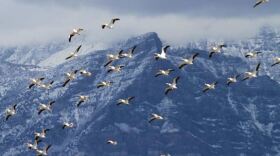 Blair Stringham oversees the management of waterfowl, cranes, band-tailed pigeons, crows and doves in Utah and assists with the management of the wildlife section for the Division of Wildlife Resources.
 -
 ProPublica investigative reporter Mark Olalde shares how, for the first time, ProPublica has cataloged cleanup efforts at more than 50 sites where uranium was processed to fuel the nation’s nuclear arsenal.
 -
 Utah Snow Survey supervisor Jordan Clayton discusses the recent snowfall and how it is impacting Utah's water storage levels.
 -
 Recycle Utah's Carolyn Wawra and a representative from InterWest Paper / Pro Recycling Group take a deep dive into recycling and what simple actions you can take in the New Year to help curb the use of plastics.
 -
 Jason Mark, Editor of Sierra Magazine provides a summary of the year’s most important stories regarding the environment. From the Inflation Reduction Act to the U.S. supreme court to why our global consumption went up along with our installation of renewables. It’s a roundup of the good, the bad, and the inspiring from the year that was.


